
🛞 Winter tyres in Gelibolu
Last updated 7 November 2026. We update this guide every November with the latest winter's data.
Bring up winter tyres in Gelibolu and most people say the same thing: "It snows here a day or two a year, and it doesn't settle." About snow they may be right. But winter tyres are made for cold tarmac, not for snow. Hourly data for the last three winters shows that every winter, 60 to 89 nights in Gelibolu drop below 7°C, and about 5 of them go below zero.[1]
Why 7 degrees?
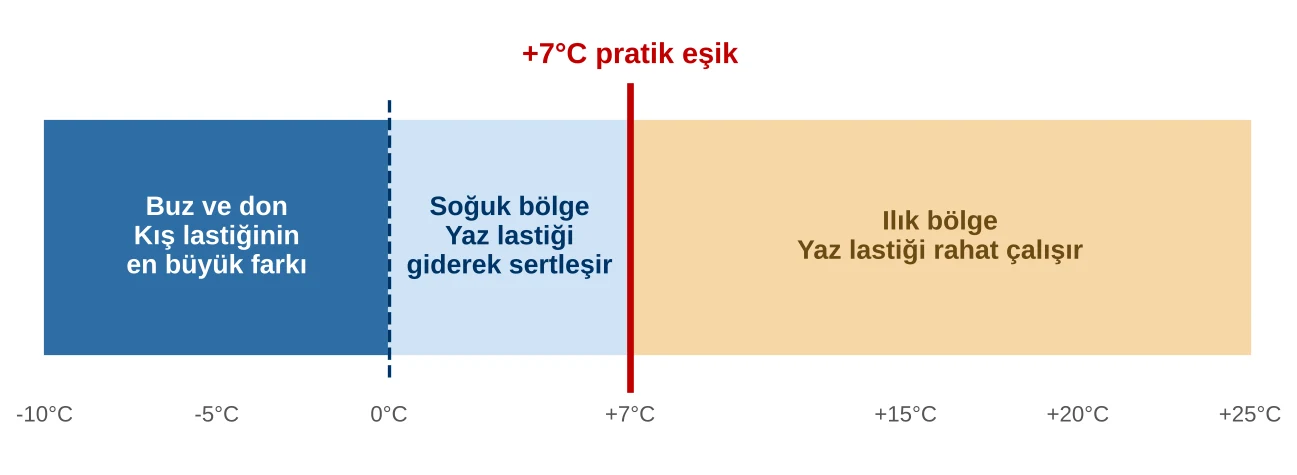
Below that, the rubber of a summer tyre hardens and grips the road less. Think of an eraser: at room temperature it grips the paper, from the freezer it slides. A winter tyre's compound stays soft in the cold. Turkey's regulation itself defines a winter tyre as one built to improve grip below 7°C.[3]
It is not a sharp line but a practical threshold tyre makers use. The colder it gets, the bigger the difference; winter tyres show their edge most on ice, snow and frost.
How many cold nights does Gelibolu get?
We went through the hourly temperature data for Gelibolu over the last three winters and counted, month by month, the days that dropped below 7°C in the evening and night and in the daytime:[1]
| Month | Evening and night (17:00-09:00) | Daytime (09:00-17:00) |
|---|---|---|
| NovemberFirst frosts in the second half of the month. | 4 (1-7) | 2 (0-4) |
| DecemberCold days come more often with the north wind. | 12 (10-16) | 10 (9-12) |
| JanuaryThe coldest month; in a cold spell the days stay cold too. | 18 (15-20) | 16 (14-18) |
| FebruaryHard cold spells and black ice are common. | 18 (11-25) | 15 (9-23) |
| MarchSunny days, but evening frost pulls it below 7°C. | 16 (14-19) | 6 (4-8) |
| AprilCool nights still carry a risk. | 4 (0-8) | 1 (0-4) |
| Winter totalEvery winter, two to three months of nights below 7°C. | 72 (60-89) | 50 (41-67) |
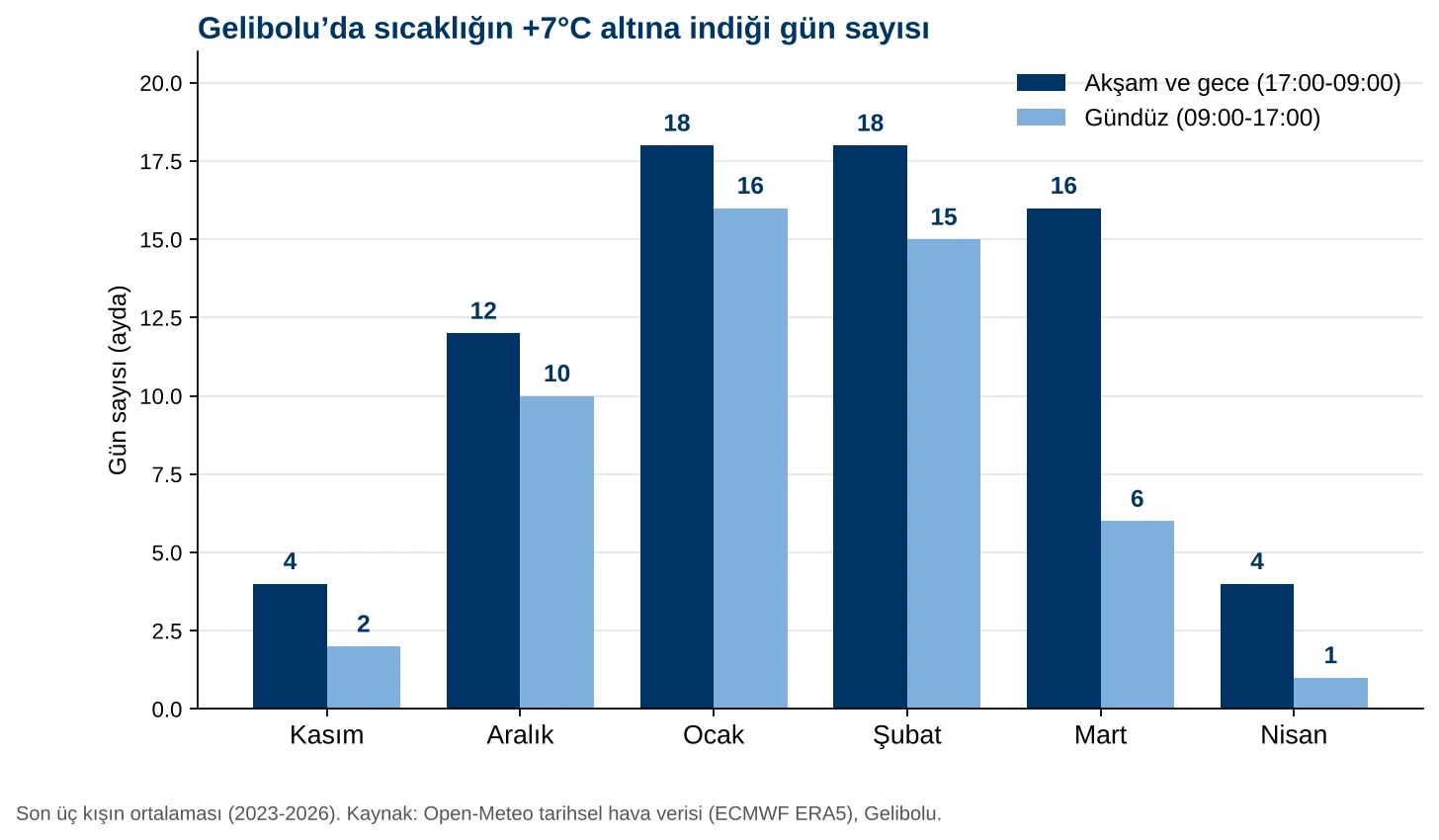
Figures are the average of the 2023-2024, 2024-2025 and 2025-2026 winters; the mildest and hardest winter are in brackets. A day counts if at least one hour in that time span was below 7°C. The data comes from a weather model (ECMWF ERA5), which can make the coast look a little milder; nights around Keşan and Malkara are usually colder.
From November to April, two to three months of nights drop below 7°C every winter. In January and February a cold spell keeps the days cold too; on about half the days it stays below 7°C even at midday. Early starts and evening drives home are exactly when summer tyres work worst.
Snow is rare but hard
Snow in Gelibolu does not fall gently. When cold air comes from the Balkans it arrives with the north wind and drifting. The deepest snow measured by the Turkish State Meteorological Service in Çanakkale was 63 cm, on 26 January 2006.[2] A sunny day can turn into a whiteout by evening. Wind piles snow onto the road, so one stretch looks clear and two metres on there is a half-metre drift.
On the Gelibolu-Keşan road, below Koru Dağı or on the Evreşe climb, one car on summer tyres sliding across the road can leave everyone behind it waiting for hours in the frost. On the town's steep streets even a centimetre of snow is enough to stop a summer tyre going up, or stopping on the way down.
Roads do not end at the town centre. Towards Istanbul, the Malkara, Keşan and Tekirdağ hills are often a few degrees colder than Gelibolu. Anyone crossing the bridge to Balıkesir and Bursa knows that frost on the plains can leave black ice on tarmac that looks dry. Fine weather in town tells you little about 40 km away.
Do all-season tyres work?
If you pick the right ones, yes. A proper all-season tyre carries the three-peak mountain and snowflake mark (3PMSF) on the sidewall. It shows the tyre passed a standard winter test on snow.[6] A tyre marked only "M+S" (mud and snow) has not passed such a test; the mark mostly describes the tread.
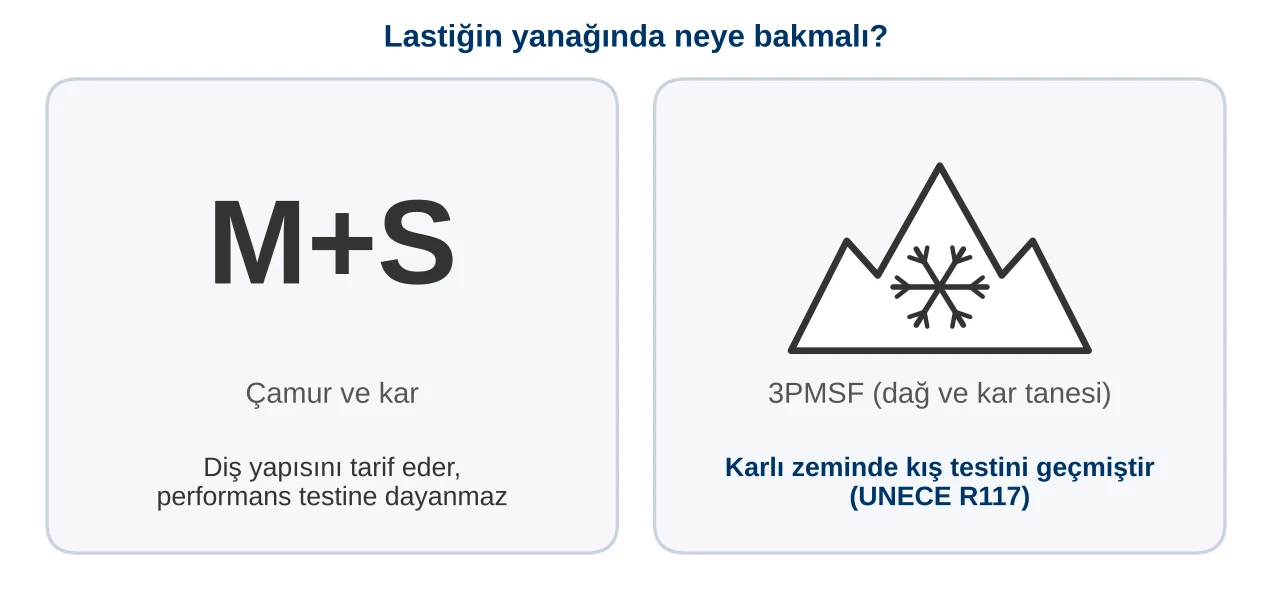
Two things are worth knowing. First, all-season tyres are not all equal: in the 2025 test by the Austrian motoring club ÖAMTC, four of 16 models were rated "good" and four "not sufficient".[5] A cheap no-name all-season tyre will not behave like a winter tyre. Second, even a good one is a compromise: a summer tyre does better on dry and wet roads, a winter tyre on snow and ice. Over Gelibolu's long, hot summer that means slightly longer braking and faster wear.
Which tyre suits you?
Gelibolu's winter is serious in cold nights but mild in snow and frost. There is no single answer; it depends on how you use the car.
A good-brand all-season tyre with the 3PMSF mark is enough if:
- you mostly drive in town and nearby villages,
- you cover under 15,000 km a year,
- you can leave the car at home on the few snowy days,
- you have nowhere to store a second set, or do not want to swap and store tyres every season.
Winter tyres in winter and summer tyres in summer are the better choice if:
- you regularly drive to Istanbul via Keşan-Malkara or over the bridge to Balıkesir and Bursa in winter,
- you have to get to work every day whatever the weather,
- you cover more than 20,000 km a year (two sets share the wear, so over time they do not cost more),
- you take long trips with heavy loads in summer.

Commercial vehicles carrying passengers or goods between cities already have a legal obligation. Whichever group you are in, the one thing not to do is spend the winter on summer tyres or on a cheap, unmarked "all-season" tyre.
Are winter tyres compulsory?
The rule covers vehicles carrying passengers or goods between cities. Since a 2025 change it runs every year from 15 November to 15 April.[4] Provincial governors can extend it by a month either side; at checks an M+S or snowflake mark on the tyre is enough.[3]
There is no legal obligation for private cars, so this is about safety, not fines. Do not be misled by the law accepting M+S; for real winter performance look for the 3PMSF mark.
Before the tyre shop
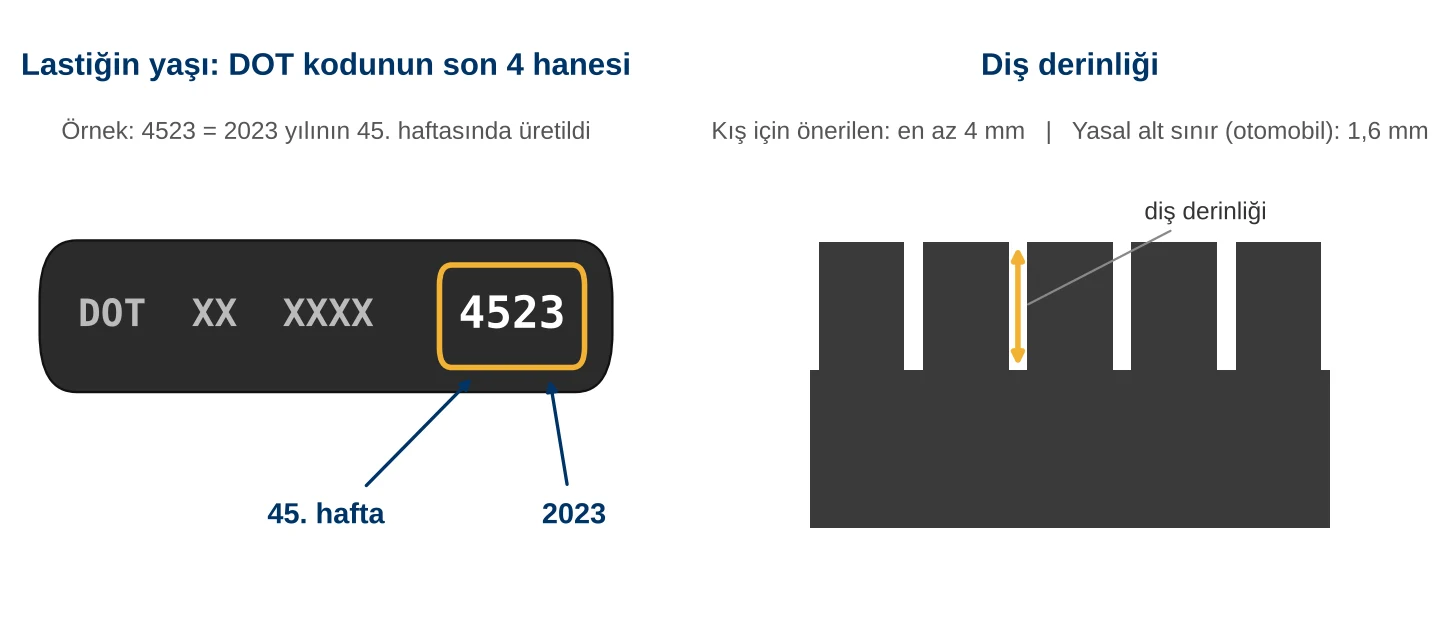
- Tread depth. The legal minimum for cars is 1.6 mm,[3] but a winter tyre should not go below 4 mm if it is to work in snow and slush.
- Age. The last four digits of the DOT code on the sidewall give the week and year the tyre was made. An old tyre hardens even with tread left; check the date when you buy and fit.
- Pressure. Tyre pressure drops in the cold; check it more often in winter.
- Before a trip. Look at the Highways Directorate's road conditions and the weather forecast before a long drive.
A last word
Four tyres can feel expensive. But in a small slide, hitting the car in front and fixing a bumper and headlight often costs more than a set of tyres. Winter or all-season, pick whichever suits how you drive. What matters is not spending the winter on summer tyres, and getting the tyres ready once the thermometer starts showing less than 7°C.
Sources
- Open-Meteo, ECMWF ERA5 historical weather data (Gelibolu, 2023-2026 winters, hourly) ↗
- Turkish State Meteorological Service, official climate statistics: Çanakkale ↗
- Winter tyre regulation (Tebliğ), Official Gazette, 1 April 2017, no. 30025 ↗
- Amendment to the regulation, Official Gazette, 4 October 2025, no. 33037 ↗
- ÖAMTC, 2025 all-season tyre test ↗
- UNECE, UN Regulation No. 117 ↗
Frequently asked
Do you need winter tyres in Gelibolu?
Snow is rare, but hourly data for the 2023-2026 winters shows 60 to 89 nights below 7°C every winter, about 5 of them below zero. Summer tyres are not advised in winter; depending on use, choose winter tyres or all-season tyres with the 3PMSF mark.
What is the 7-degree rule?
A practical threshold below which summer tyre rubber starts to harden and grip less. Turkey's winter tyre regulation also defines a winter tyre as one built to improve grip below 7°C. It is not a sharp line; the colder it gets, the bigger the difference.
When should winter tyres go on in Gelibolu?
Nights below 7°C begin in November and reach about 12 a month in December. Fitting them in the second half of November and taking them off in mid-April covers the first frosts and the late cold spells.
Which are the coldest months in Gelibolu?
January and February. Over the last three winters about 18 nights a month dropped below 7°C, and in a cold spell about half the days stayed below 7°C as well.
Are winter tyres compulsory for private cars?
No. The rule covers vehicles carrying passengers or goods between cities, every year from 15 November to 15 April. There is no legal obligation for private cars, but they are advised for safety.
Can all-season tyres replace winter tyres?
A good-brand all-season tyre with the 3PMSF mark is enough for cars used mostly in town and driven under 15,000 km a year. For frequent winter trips via Keşan-Malkara or over the bridge, and for high mileage, winter tyres are safer.
What is the difference between M+S and 3PMSF?
M+S (mud and snow) describes the tread and is not based on a performance test. The 3PMSF mark shows the tyre passed a standard test on snow (UNECE R117). Both are accepted at checks in Turkey, but look for 3PMSF for real winter performance.
What is the minimum tread depth for a winter tyre?
The legal minimum for cars is 1.6 mm. A winter tyre should not go below 4 mm if it is to work in snow and slush.